
Divided opposition is Ruto's real advantage, survey suggests

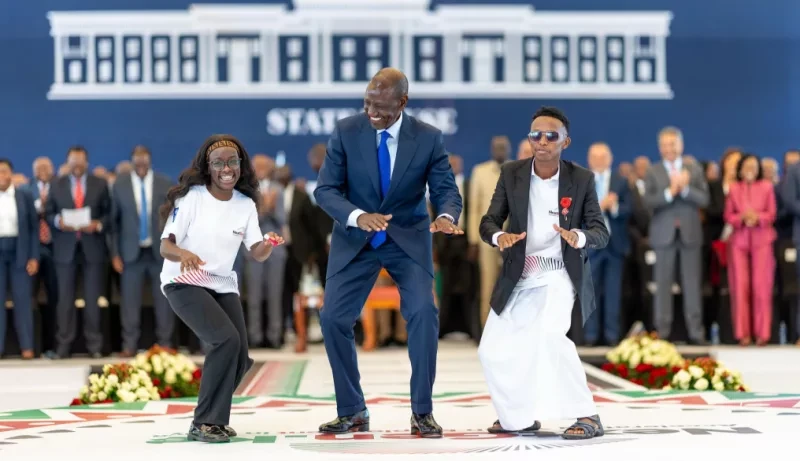
President William Ruto's apparent lead in the race to retain incumbency may owe more to a fragmented opposition than to overwhelming national support, a new survey by TIFA Research suggests.

The survey shows that while Ruto currently enjoys the backing of 24 per cent of Kenyans, support for opposition figures remains split among several contenders, leaving none with enough individual backing to mount a strong challenge if the election were held under the current political landscape.
Findings place Nairobi Senator Edwin Sifuna as his closest challenger with 15 per cent support, followed by Fred Matiang'i at 14 per cent, Kalonzo Musyoka at 13 per cent and Rigathi Gachagua at 7 per cent.
Twenty per cent of respondents said they were still undecided.
The findings suggest that, all things remaining constant, the opposition's divided vote could hand Ruto a significant advantage despite his relatively modest national support.
The regional breakdown also points to a broader challenge facing the opposition.
Each of the leading opposition figures draws most of their support from their traditional political strongholds.
Kalonzo enjoys his strongest backing in Lower Eastern at 58 per cent, Matiang'i performs best in Nyanza with 29 per cent and Mt Kenya with 18 per cent, while Sifuna records his highest support in Western at 28 per cent, the Coast at 27 per cent and Nairobi at 22 per cent.
Gachagua's strongest base remains Mt Kenya, where he attracts 19 per cent support.
In view of this fragmentation, the survey suggests that Ruto's current lead may be more a reflection of opposition's lack of unity than his broad national dominance.
TIFA reached a similar conclusion in its analysis, noting that while the President leads the field, "the Opposition has considerable opportunity" because his support stands at only about one-quarter of Kenyans.
It cautioned, however, that support for the various opposition leaders remains largely concentrated in regional and ethnic bases, making it difficult to determine how much backing a single opposition candidate would command if one were eventually agreed upon.
The research organisation said only a survey conducted after the opposition settles on a single presidential candidate and running mate would provide a clearer indication of the electoral contest.
As such, only a survey conducted after a 'single Opposition candidate' (and DP running-mate) is agreed upon... will it be possible to at least gauge presidential electoral popularity," TIFA said.
However, the same survey also indicates that the President's own electoral position may be far from secure.
Ruto commands an outright majority only in Northern Kenya, where 61 per cent of respondents said they would prefer him to win re-election in the 2027 presidential election.
Elsewhere, support falls below the 50 per cent mark, including 49 per cent in Central Rift, 30 per cent in Nyanza, 21 per cent at the Coast, 15 per cent in Lower Eastern, 14 per cent in Western and just 8 per cent in Mt Kenya.
The findings are based on the views of 2,048 randomly selected Kenyan adults aged 18 and above interviewed face-to-face across all 47 counties between June 13 and June 22, 2026.
Interviews were conducted mainly in Swahili and English across nine survey zones: Central Rift, Coast, Lower Eastern, Mt Kenya, Nairobi, Northern, Nyanza, South Rift and Western.
The study, funded by TIFA Research, has a margin of error of plus or minus 2.18 per cent.
It sought to gauge the current political environment and issues surrounding the 2027 General Election.
TIFA nevertheless cautioned against treating the findings as a prediction of the election outcome, saying public opinion may have shifted since the fieldwork was conducted.
In considering these results, however, it is important to acknowledge that various events occurred both during the period of data collection and after that may have impacted public views such that were the identical questions to be asked in a similar survey today, somewhat different results might emerge," the organisation said.
"Still, the results presented here constitute an accurate picture of Kenyans' views on the subjects covered at the time they were collected."
What's Your Reaction?
 Like
0
Like
0
 Dislike
0
Dislike
0
 Love
0
Love
0
 Funny
0
Funny
0
 Wow
0
Wow
0
 Sad
0
Sad
0
 Angry
0
Angry
0












Comments (0)