
Lawyer Ndegwa Njiru defends Ruto remarks, cites constitutional rights

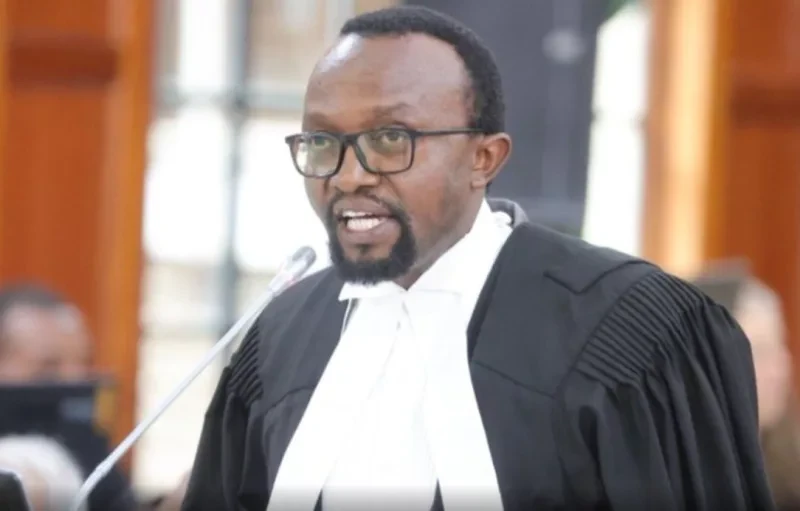
Wiper Patriotic Front (WPF) spokesperson Ndegwa Njiru has cited the Constitution in response to his summons by the National Cohesion and Integration Commission (NCIC) over remarks he made about President William Ruto.

Njiru argued that the Constitution protects freedom of expression, conscience, thought, belief and opinion, including the right to hold positive or negative opinions about political leaders and institutions.
The NCIC summoned the lawyer over remarks he made against President Ruto during a political rally in Wamunyu, Mwala Constituency, Machakos County, on November 22.
In a summons dated November 26, the commission directed Njiru to appear before it on December 3 at 11 am to respond to concerns arising from his statements.
The NCIC said it was investigating the remarks over concerns that they could undermine national cohesion and potentially trigger political and ethnic hostilities.
Among the statements under investigation are Njiru's claims that President Ruto had presided over the deaths of young people, corruption and the alleged sale of Safaricom.
"We have tried with this rubbish called William Ruto. He has killed our children, this William Ruto has brought corruption, this William Ruto has stolen our property, he has sold Safaricom and finished Kenya," Njiru allegedly said.
In a post on X, Njiru acknowledged receiving the commission's summons and indicated that he would comply with the directive.
"To: NCIC. I acknowledge receipt of your summons and confirm that the same shall be acted upon appropriately and in accordance with the law," he said.
However, Njiru questioned the constitutional basis for scrutinising his opinion of the President, citing Article 32(1) of the Constitution, which guarantees freedom of conscience, religion, thought, belief and opinion.
He argued that the constitutional protection applied regardless of whether an opinion was favourable or critical of an individual, public office or institution.
"The freedom of conscience, belief and/or opinion guaranteed under the aforesaid Article is unrestricted as to its content. Such conscience, belief and/or opinion may be either positive or negative," Njiru stated.
He added that the Constitution did not require Kenyans to maintain favourable opinions about people holding public office.
"The Constitution nowhere imposes any obligation upon any person to hold a positive conscience, belief and/or opinion in respect of any individual, office or institution. A negative conscience, belief or opinion is equally protected under Article 32 of our Constitution," he said.
Njiru further maintained that the Constitution protects the freedom to form and hold opinions without prescribing what those opinions should be.
He is expected to appear before the commission on December 3 to respond to the concerns raised over his remarks.
What's Your Reaction?
 Like
0
 Dislike
0
 Love
0
 Funny
0
 Wow
0
 Sad
0
 Angry
0














Comments (0)