
Ruto rejects public procurement Bill, sends it back to Parliament

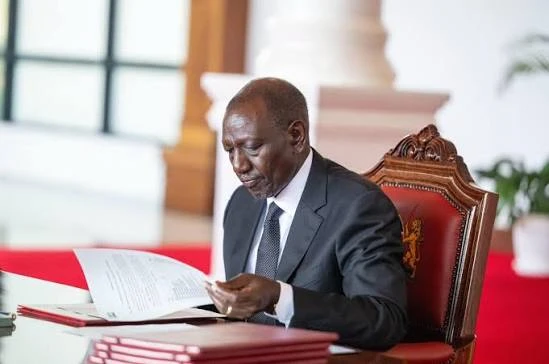
President William Ruto has declined to assent to the Public Procurement and Asset Disposal (Amendment) Bill, 2024, sending it back to Parliament over concerns that some of its provisions could undermine Kenya's investment climate and create inconsistencies in public procurement laws.

National Assembly Speaker Moses Wetang'ula informed MPs on Tuesday that the President exercised his constitutional powers under Article 115(1)(b) of the Constitution to refer the Bill back to the House for reconsideration, accompanied by a memorandum detailing his reservations.
"I wish to convey to the House a message from His Excellency the President regarding the referral of the Public Procurement and Asset Disposal Amendment Bill, National Assembly Bill No. 48 of 2024, back to Parliament for reconsideration," Wetang'ula said.
He told MPs that the President had declined to sign the Bill and instead returned it with proposed amendments affecting numerous clauses.
"The President has expressed reservations on Clauses 2, 3, 6, 7, 8, 11, 12, 13, 14, 15, 16, 18, 19, 20, 21, 22, 23, 24, 25, 26 and 27 of the Bill," the Speaker said.
According to the memorandum, one of the President's principal concerns relates to the Bill's definition of local and foreign firms, which he argues is impractical and inconsistent with the government's broader economic agenda.
"Chief among these concerns is the definition of foreign and local firms, which is impractical and inconsistent with the government's goal of attracting foreign direct investment, mobilising private capital and improving the business environment," Wetang'ula said while reading the President's message.
The amendment Bill had already been approved by both Houses of Parliament, having been passed by the National Assembly on November 28, 2024, and later by the Senate on May 12, 2026, before being forwarded to the President for assent.
Under Article 115 of the Constitution, the President may either assent to a Bill or refer it back to Parliament with reservations for reconsideration.
Following the referral, Wetang'ula directed the Departmental Committee on Finance and National Planning to urgently examine the President's objections and table its report within the constitutional timelines.
"Standing Order 154(2) requires the House to consider the President's reservations within 21 days upon receipt of the memorandum," he said.
The Speaker said the committee would be expected to scrutinise the reservations and make recommendations to enable the House to decide whether to accommodate the President's proposals or override them through the constitutional voting threshold.
He reminded MPs that only the clauses specifically objected to by the President would be open for reconsideration.
"For avoidance of doubt, only sections of the Bill that have reservations ought to be considered," Wetang'ula ruled.
He further directed the Clerk of the National Assembly to circulate the presidential memorandum to all members to familiarise themselves with its contents ahead of debate.
Once the National Assembly concludes consideration of the President's reservations, its decision will be transmitted to the Senate for concurrence before the legislative process is completed.
The latest referral marks another instance of the Head of State invoking constitutional powers to seek changes to legislation after it has cleared Parliament, underscoring the Executive's role in reviewing laws before they take effect.
What's Your Reaction?
 Like
0
Like
0
 Dislike
0
Dislike
0
 Love
0
Love
0
 Funny
0
Funny
0
 Wow
0
Wow
0
 Sad
0
Sad
0
 Angry
0
Angry
0















Comments (0)