
Poll: Over half of Kenyans still oppose broad-based government

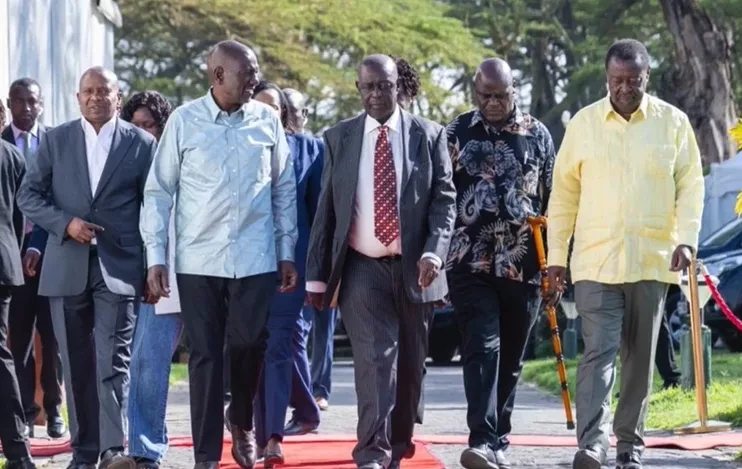
More than half of Kenyans have mainatined their disapproval of the broad-based government (BBG) UDA and ODM, a new survey shows.

The latest poll by TIFA Research found that 52 per cent of Kenyans oppose the arrangement, compared with 30 per cent who support it.
Another 15 per cent said they had no opinion, while four per cent said they were unaware of the de facto coalition between UDA and ODM.
The findings are contained in TIFA’s second survey on the BBG collected between June 13 and 22, 2026.
The survey was conducted through face-to-face household interviews with 2,048 randomly selected Kenyan adults aged 18 and above across all 47 counties.
The respondents were drawn from nine geographical zones: Central Rift, Coast, Lower Eastern, Mt Kenya, Nairobi, Northern, Nyanza, South Rift and Western.
The survey has a margin of error of plus or minus 2.18 percentage points. The findings show that support for the BBG has remained below one-third of the population in four of TIFA’s past five surveys, with the exceptions being May and August 2025.
Support stood at 22 per cent in May 2025 and rose to 29 per cent in August before settling at 30 per cent in the latest survey.
Opposition to the arrangement has also remained high, although it has declined from levels recorded last year.
In May 2025, 54 per cent of Kenyans opposed the BBG. The figure rose to 64 per cent in August before falling to 48 per cent in October, when support and opposition were closer, at 44 per cent and 48 per cent respectively.
The latest opposition level of 52 per cent is also lower than the 56 per cent recorded in the previous TIFA survey in May 2026.
TIFA said the stability in support for the BBG could be linked to divisions within ODM over President William Ruto’s re-election bid and related political issues.
“The current level of support is identical to what it was in May (30 per cent), suggesting that the continuing split within ODM over the matter of supporting the President’s re-election bid (and related matters) has appeared to have created a fairly stable ‘ceiling’ as to how much support the BBG can attract,” the report says.
The survey also points to a strong relationship between Kenyans’ views of the BBG and their level of trust in political leaders and public institutions.
Among those who oppose the arrangement, 58 per cent said they had “none at all” trust in President William Ruto.
By comparison, 22 per cent of BBG supporters said they had “a lot” of trust in the President, nearly four times the six per cent recorded among opponents.
However, trust was not uniform even among BBG supporters as 19 per cent said they had no trust at all in Ruto, while 36 per cent said they had “some” trust and 21 per cent reported “very little” trust.
Two per cent of both BBG supporters and opponents said they were unsure about their level of trust in the President.
The divide was also evident in views of the Judiciary. More than half, 52 per cent, of BBG opponents said they had no trust at all in the Judiciary, compared with 24 per cent among supporters.
Among BBG supporters, 11 per cent said they had “a lot” of trust in the Judiciary, 30 per cent had “some” trust and 33 per cent had “very little” trust.
Among opponents, only five per cent expressed “a lot” of trust, while 15 per cent had “some” trust and 28 per cent had “very little” trust.
The sharpest divide, however, was recorded in attitudes towards the Independent Electoral and Boundaries Commission (IEBC).
“Such a polarization is far greater with regard to the IEBC than it is to political parties. Specifically, three times as many BBG supporters express ‘a lot of trust’ in the IEBC as do BBG opponents (19 per cent vs. 6 per cent),” the report says.
Among BBG opponents, 47 per cent said they had no trust at all in the IEBC, 26 per cent had very little trust and 18 per cent had some trust.
Among supporters, 19 per cent said they had a lot of trust in the electoral commission, while 23 per cent had some trust and 24 per cent had very little trust.
The pattern was similar when respondents were asked about other institutions.
Distrust of the police was higher among BBG opponents, with 48 per cent saying they had no trust at all, compared with 31 per cent among supporters.
The same trend was recorded for political parties, where 42 per cent of opponents expressed no trust compared with 28 per cent of supporters.
For county government leadership, 44 per cent of BBG opponents said they had no trust at all, compared with 26 per cent among supporters.
There was little difference between the two groups among those who said they had “very little” trust in county government leadership, with both BBG supporters and opponents recording 29 per cent.
The findings suggest that attitudes towards the BBG remain closely linked to broader perceptions of the President, political institutions and the country’s electoral system.
What's Your Reaction?
 Like
0
Like
0
 Dislike
0
Dislike
0
 Love
0
Love
0
 Funny
0
Funny
0
 Wow
0
Wow
0
 Sad
0
Sad
0
 Angry
0
Angry
0















Comments (0)