
Uhuru lays wreath at Moi, Mama Lena’s graveside in Kabarak
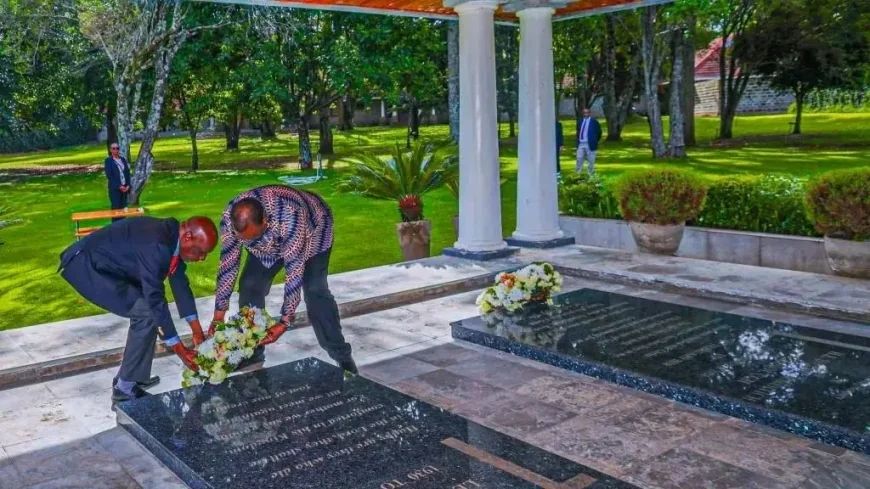
Retired President Uhuru Kenyatta on Friday laid a wreath at the graveside of the late President Daniel Moi and his wife, Mama Lena Moi, at the family home in Kabarak, Nakuru county, in a moment that underscored the long political relationship between Kenya’s first two ruling families.

Moi, Kenya’s second President and its longest-serving head of state, died in the early hours of February 4, 2020, while receiving treatment at the Nairobi Hospital. He was 95.
He was laid to rest at Kabarak beside Mama Lena Moi, who died on July 22, 2004, at the age of 74.
In a brief statement, Uhuru’s office said the former President paid “tribute to the founding visionaries of the institution,” an apparent reference to the Nyayo philosophy that defined Moi’s political leadership and governance approach for nearly a quarter of a century.
Moi assumed office in 1978 after the sudden death of President Jomo Kenyatta, Uhuru’s father and Kenya’s founding leader.
Kenyatta had led the country for 15 years, first as Prime Minister from 1963 to 1964, and then as President from December 1964 until his death in August 1978.
Moi served as Kenyatta’s Vice President before constitutionally succeeding him as Kenya’s second President, a transition that cemented a political bond between the two families that would endure for decades.
Moi went on to lead the country until 2002, shaping Kenya’s political landscape through periods of single-party rule and later multiparty politics.
That bond was again demonstrated in 2001, when Moi orchestrated Uhuru’s nomination to Parliament as Gatundu South MP and appointed him to Cabinet as Minister for Local Government.
The nomination and appointment marked Uhuru’s formal entry into national politics.
The following year, Moi endorsed Uhuru as his preferred political heir in the 2002 General Election, a move that caused disquiet among senior political figures of the time, including then Vice President George Saitoti and Raila Odinga, a former adversary who had later allied with Moi.
The endorsement reinforced a pattern of mutual political support and succession that has long characterised relations between the Moi and Kenyatta families.
That continuity was again evident during Friday’s visit, with images shared online showing Uhuru being received at Kabarak by Moi’s son, Gideon Moi, the Kanu national chairmaN.
Uhuru held the party position between 2005 and 2007 when he led Kanu into a coalition with Kibaki under the Party of National Unity (PNU).
The interaction reflected both a personal and political relationship that has endured beyond the presidencies of their fathers.
Following the 2002 transition, Uhuru remained a central figure in national politics. After the disputed 2007 General Election, he joined President Mwai Kibaki’s Grand Coalition Government, first serving as Minister for Local Government from January 2008.
He was later appointed Deputy Prime Minister and Minister for Trade in April 2008, before being elevated to Deputy Prime Minister and Minister for Finance from 2009 to 2012.
Uhuru went on to serve as Kenya’s fourth President from 2013 to 2022.
He currently serves as the African Union–Kenya Peace Envoy and Facilitator of the EAC-led Nairobi Peace Process, a role that continues to place him at the centre of regional diplomacy.
What's Your Reaction?
 Like
0
Like
0
 Dislike
0
Dislike
0
 Love
0
Love
0
 Funny
0
Funny
0
 Wow
0
Wow
0
 Sad
0
Sad
0
 Angry
0
Angry
0
I am a passionate blogger tech enthusiast and founder of 8T8 Media a digital platform dedicated to sharing tech insights news updates and thought-provoking content. My journey into blogging began with a love for writing and a deep interest in how technology shapes our lives. Over time I expanded my focus to include not just tech but also political news current affairs and updates across fields like business education and lifestyle. Through 8T8 Media I aim to keep my audience informed with relevant and timely content that reflects real issues and developments around us. I break down complex tech topics into easy reads and share important news stories that matter to individuals and communities. My approach is rooted in authenticity consistency and a genuine desire to empower others with information. I believe that blogging is more than just writing it's about connecting people to knowledge ideas and opportunities. Whether you're into gadgets tech trends or just want to stay updated on what's happening around you my content is created to engage inform and inspire. 8T8 Media is my way of contributing to a more informed digital world and I'm proud to use my voice to share stories that matter.



Comments (0)